


5 Essential Scaffolding Safety Tips for Construction Sites in India
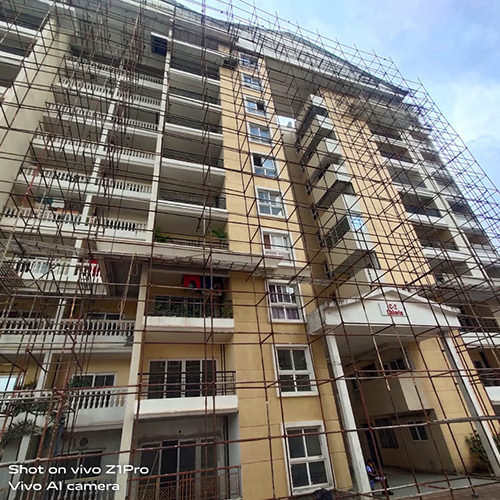
5 Essential
Scaffolding Safety Tips Every Construction Site in India Must Follow
India loses nearly 48,000 workers to occupational accidents
every year — and falls from scaffolding are among the leading causes. If your
site is in Bangalore or anywhere across Karnataka, here is what you need to
know to stay safe, stay legal, and keep your project on track.
48,000Occupational deaths in India per year, with scaffold
falls a major contributor
70%Of scaffold accidents happen because of poor inspections
or improper assembly
18%Of all fall injuries on Indian construction sites involve
scaffolding
2 mHeight at which guardrails become mandatory under Indian
Standard IS 3696
India's scaffolding legal framework Compliance with IS 3696
(Safety Code for Scaffolds) and IS 4014 (Steel Tubular Scaffolding) is
mandatory under the Building and Other Construction Workers (BOCW) Act, 1996.
In Karnataka, sites must also comply with the Karnataka Factories Act and local
OSHA-equivalent guidelines. Non-compliance can result in project shutdowns and
legal liability.
·
Inspect before every shift — not just once
Most scaffolding accidents happen in the first week of use,
often because a single pre-work inspection was skipped. IS 3696 requires
inspection by a competent person before each shift, after heavy rain or strong
winds, and after any structural impact or modification.
During inspection, look for:
- Loose
couplers, missing locking pins, or deformed tubes
- Damaged
or warped planks — a single weak board can cause a collapse
- Corroded
base plates or inadequate mud sills
- Missing
guardrails, mid-rails, or toe boards at any platform 2 m or higher
- Tag
colour — Green = safe to use, Yellow = caution/repairs needed, Red = do
not use
The three-tag colour system is now standard on most large
Bangalore construction sites and is strongly recommended by Indian safety
consultants as a simple, language-neutral communication tool for mixed-language
workforces.
·
Use the right fall protection — harnesses are not optional
Falls are the single largest cause of scaffolding
fatalities. Yet on many Indian construction sites, personal protective
equipment (PPE) is either absent or worn incorrectly. The law is clear:
full-body safety harnesses connected to a lifeline are mandatory when working
above 2 metres on any scaffold without a compliant guardrail system.
Your fall protection checklist should include:
- Full-body
harness (not a waist belt) with a rated anchor point
- ISI-marked
safety helmet with chin strap
- Non-slip
footwear — avoid smooth-soled chappals entirely
- Guardrails
at top rail (≥950 mm), mid-rail, and toe board on all open sides
- Debris
netting or catch platforms on multi-storey scaffolds
Inspect PPE before every use. A harness that has absorbed a
fall must be replaced immediately, even if it appears undamaged.
·
Respect load limits — distribute weight evenly
Every scaffold carries a rated load capacity. Overloading —
even temporarily — is one of the most common causes of structural collapse. In
India, the problem is compounded by the common practice of stacking bricks,
cement bags, and tools on the same platform where workers are standing.
Follow these rules without exception:
- Never
exceed the manufacturer's rated capacity — check the datasheet, not your
estimate
- Distribute
materials evenly across the platform, not stacked in one corner
- Account
for the combined weight of workers, tools, and materials at once
- Remove
materials from the scaffold at the end of each shift
- Use a
separate hoist for lifting heavy loads — never drag materials up the
scaffold
·
Prepare the ground before the first pole goes in
Bangalore's varied terrain — from rocky outcrops in the
north to soft laterite soil in the east — makes ground preparation a
site-specific task, not a standard procedure you can skip. A scaffold on
unstable ground will shift, settle, or tip, regardless of how well the upper
structure is assembled.
Before installation:
- Confirm
the soil can bear the full scaffold load, including dynamic loads from
workers moving
- Use
sole boards (minimum 250 mm × 38 mm timber) under base plates to spread
the load
- Level
and compact the surface — any slope beyond 1:4 needs engineer sign-off
- Keep
drainage channels clear — waterlogged soil loses bearing capacity rapidly
- Re-check
ground conditions after monsoon rains, which are heavy in Bangalore from
June to September
·
Train workers — and document it
The BOCW Act, 1996 requires that all workers involved in
scaffolding operations receive formal safety training. This is not just about
ticking a compliance box — research consistently shows that untrained workers
are dramatically more likely to be involved in scaffold accidents than those
who have completed even a basic course.
Effective training must cover:
- Types
of scaffolding and when each is appropriate (tube and coupler, frame,
suspended)
- Erection
and dismantling sequence — never work from the top down without fall
protection
- Hazard
identification and what to do when a hazard is spotted mid-shift
- Emergency
procedures — what happens if someone falls or a section collapses
- The
three-tag colour system and who has authority to change a tag
Critically, conduct training in the workers' primary
language. Many Bangalore sites have workforces speaking Kannada, Tamil, Telugu,
and Hindi. A safety briefing in a language no one understands is not a safety
briefing.
Frequently
asked questions
What is
the main scaffolding safety standard in India?
IS 3696 (Part 1), issued by the Bureau of Indian Standards,
is the primary safety code governing the erection, use, and dismantling of
scaffolds. IS 4014 applies specifically to steel tubular scaffolding. Both are
mandatory under the BOCW Act, 1996.
At what
height is a guardrail legally required on scaffolding in India?
IS 3696 requires a full guardrail system — top rail,
mid-rail, and toe board — on any scaffolding platform that is 2 metres or more
above ground level.
How often
should scaffolding be inspected on an active construction site?
Inspections should occur before each working shift, after
any adverse weather event (heavy rain, strong winds), after any impact or
structural modification, and at a minimum of weekly intervals on long-duration
projects.
Can
bamboo scaffolding still be used in Bangalore?
Yes, bamboo is permitted for small or low-height projects,
but it must still comply with IS 3696. This means the bamboo must be inspected
for strength, tied securely, and replaced the moment any cracking or rot is
detected.
Who can
legally inspect scaffolding in India?
Only a "competent person" as defined under the
BOCW Act — someone with formal safety training and demonstrable knowledge of IS
codes who can identify structural hazards and has the authority to take
scaffolding out of service.
Need Certified Scaffolding in Bangalore?
NA Group provides IS 3696-compliant scaffolding rental
services in Bangalore for residential, commercial, and industrial
construction projects. Our trained erection teams ensure safe installation,
regular inspections, and complete safety documentation to help your project
remain compliant and efficient.
Whether you need scaffolding for building construction,
maintenance work, or industrial applications, NA Group delivers reliable and
safe scaffolding solutions tailored to your project requirements.