


Scaffolding for Apartment Projects: MS & Aluminium Scaffolding Solutions
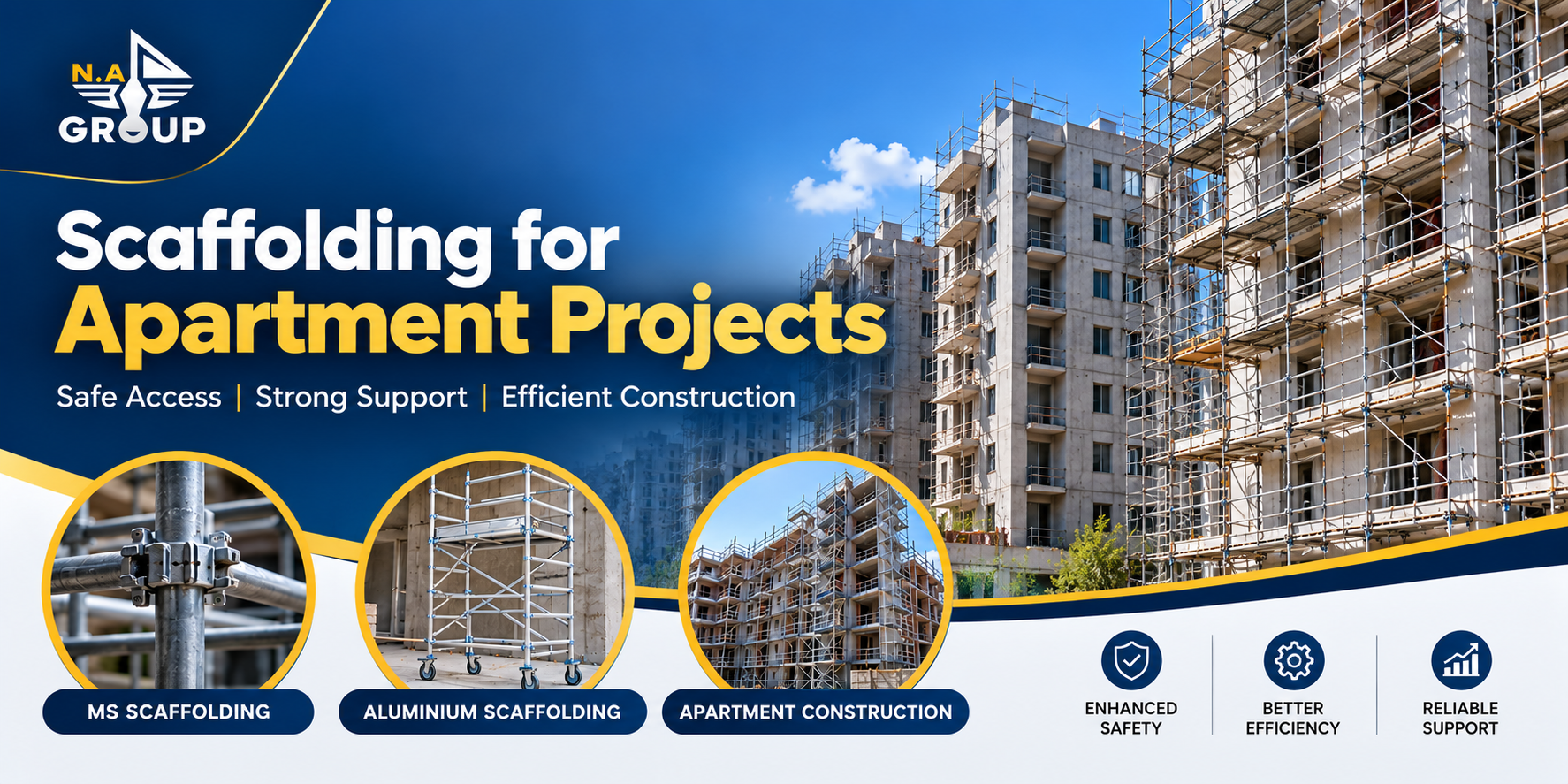
Scaffolding Solutions for Apartment Projects: Safety, Efficiency, and Best Practices
Constructing or maintaining multi-story residential apartments demands elevated access that balances worker safety, structural load handling, and fast turnaround cycles. Unlike single-story builds, mid-rise and high-rise apartment blocks require scaffolding setups that adapt to varied building envelopes, allow staggered trade work (bricklaying, plastering, painting, glazing), and maintain stability across changing weather conditions.
Whether you are planning a new residential tower or scheduling exterior refurbishment, here is a complete guide to choosing and deploying scaffolding for apartment construction—backed by industry standards from
1. Why Apartment Projects Demand Specialized Scaffolding
Apartment projects move through phased elevations. At any given time, external masonry teams, electrical conduits, window installers, and plasterers work along the vertical perimeter. Standard ad-hoc staging cannot meet the safety and logistical benchmarks needed here:
High Vertical Load Capacity: Platforms must comfortably bear the combined weight of multiple workers, mortar trays, heavy blocks, and power tools.
Facade Complexities: Cantilevered balconies, duct cut-outs, and architectural projections require modular scaffolding that can navigate setbacks without compromising rigidity.
Sequential Handover: A reliable system allows trades to dismantle lower levels or leapfrog tiers upward as structural slabs cure.
2. Ideal Scaffolding Systems for Apartment Construction
| System Type | Primary Use Case in Apartments | Key Advantages |
| Structural masonry, external plastering, heavy facade cladding | • High load capacity • Rigid 4-point node locking system • Fast assembly without loose bolts or couplers | |
| Interior finishing, double-height lobbies, ceiling MEP, touch-up painting | • Lightweight & mobile (lockable caster wheels) • Rapid relocation by small crews • Non-marking on finished flooring | |
| Cantilever / Suspended Cradles | High-rise exterior painting, glass facade installation, patch repairs | • Requires zero ground footprint • Ideal over busy driveways, basements, or landscape zones |
3. Phased Implementation Across Apartment Build Stages
Substructure & Slab Casting (Centering & Shuttering): Heavy-duty MS props, H-frames, and Cuplock standards provide the shoring support required under freshly poured concrete slabs and beams.
Superstructure & Block Masonry: External Cuplock scaffolding runs continuously along the perimeter, fitted with full-width metal walk-boards, double guardrails, and toe-boards to allow safe block transport.
Plastering & Exterior Painting: Deployed with heavy-duty shade netting/debris nets to contain dust and prevent falling hazards while crews apply weather-proof coatings.
Balcony & Utility Finishing: Mobile aluminium towers or suspended systems handle electrical fittings, AC pipe routing, and terrace edge installations with minimum disruption.
4. Renting vs. Buying Scaffolding for Builders
For most residential developers and general contractors, renting scaffolding equipment offers distinct financial and operational advantages over direct purchase:
Zero Capital Lock-up: Shift high capital expenditure (CapEx) to predictable, phase-wise operational costs (OpEx).
No Long-term Yard Storage: Once the exterior finishing is handed over, the rental vendor demobilizes the stock, eliminating off-site storage and transit costs.
Certified Quality Checks: Established rental providers inspect pipes, couplers, pins, and boards for fatigue, corrosion, or weld cracks before each dispatch.
5. Critical On-Site Safety Protocols
Base Plate & Sole Board Anchoring: Never erect standards on raw soil or loose backfill. Always use solid wooden sole plates and adjustable screw jacks to distribute vertical dead loads evenly.
Wall Ties & Anchors: Tie the scaffold framework directly into structural columns or slab edges at scheduled vertical and horizontal intervals (typically every two lifts) to prevent sway and wind-load pullout.
3-Point Guardrail Protection: Working tiers must include top rails (at 1 m to 1.1 m), mid rails, and toe boards (minimum 150 mm) to stop dropped tools and curb edge trips.
Overhead Protection & Debris Mesh: Install heavy-gauge safety nets around the entire scaffolding perimeter to protect ground-level workers and pedestrians from falling rubble.
Source Scaffolding with NA Group
Securing durable, precision-engineered scaffolding on time is critical to avoiding structural delays.
Complete Inventory: Heavy-duty MS Cuplock systems, mobile aluminium scaffold towers, centering sheets, adjustable props, and accessories.
Flexible Rental Models: Scalable rental volumes tailored to short-duration renovations or multi-month apartment tower schedules.
Project Support: Prompt site logistics, delivery, and equipment matching for projects in Sarjapur, Devanahalli, Whitefield, and across Karnataka.
Get in touch with NA Group at